Every year, millions of batteries reach the end of their lives, filled with metals we have fought hard to extract, yet destined for landfills or low-grade recycling. The disconnect between how much we value what's inside and how little we recover is striking. As electric vehicles and renewable energy drive battery demand higher, the waste problem is only growing.
What if smarter, cleaner ways existed to reclaim these resources? Today, artificial intelligence and quantum computing are stepping into this challenge, offering new ways to rethink battery upcycling—making it faster, more precise, and far more sustainable than anything we’ve managed before.
Why Sustainable Battery Upcycling Matters?
Inside every discarded battery lies a trove of lithium, cobalt, nickel, and other valuable metals — all of which are costly to mine and harsh on the planet to extract. Mining these materials drains huge amounts of water, scars landscapes, and pumps out greenhouse gases. Tossed into landfills, old batteries don't just waste those resources; they leak toxic chemicals into soil and water, leaving pollution that lingers for decades. Upcycling offers a smarter path, recovering these metals and giving them a second life in products that match or even exceed the original quality.
However, modern batteries are far from simple. They come in countless chemistries, designs, and coatings that make disassembly tricky and slow. Manual sorting is error-prone, and the most common industrial methods — smelting or acid baths — often destroy valuable materials and leave behind hazardous sludge. To make upcycling truly sustainable, we need faster, cleaner, and more precise techniques. That’s where artificial intelligence and quantum computing come in, bringing advanced tools to untangle this complexity and recover more from every cell with far less harm.
How AI Helps Optimize Upcycling Processes?
Artificial intelligence is already making headway in streamlining battery upcycling by bringing pattern recognition and predictive capabilities to a field that has long relied on trial and error. At battery collection facilities, AI-driven vision systems are being trained to quickly identify battery types, chemistries, and conditions by scanning labels, shapes, and surface wear. This automatic sorting ensures that batteries with different chemistries — such as lithium-ion, nickel-metal hydride, or lead-acid — don’t get mixed, which would otherwise lower recovery efficiency or create safety hazards.
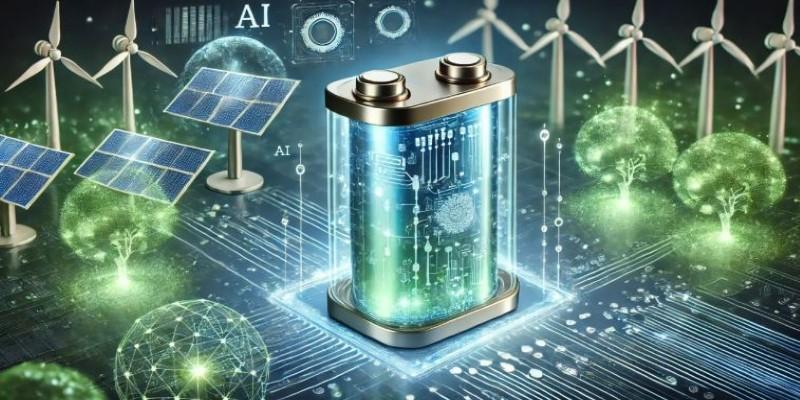
Beyond sorting, AI is being applied to optimize the chemical recovery process itself. Algorithms analyze large sets of data from pilot experiments to find the right combination of solvents, temperatures, and reaction times that maximize material recovery while minimizing waste. These models can predict how a given process will behave with batteries of slightly different compositions — a task too complex and variable for humans to handle effectively. This has shortened the research cycle for developing improved methods and reduced the need for hazardous experimentation.
In manufacturing, some startups are exploring AI to enhance the quality of recovered materials, allowing them to re-enter production lines without downcycling. For example, cathode materials salvaged from used batteries often degrade over time. AI models help adjust the particle size, crystal structure, and surface coatings during refurbishment to restore or even enhance their properties. This keeps the material "in the loop" for longer and avoids the need to mine fresh metals.
Quantum Computing’s Emerging Role
Quantum computing is still in its early stages, but its potential for tackling the most intricate problems in battery upcycling is already clear. Many of the chemical reactions involved in dissolving, separating, and reconstructing battery materials are governed by quantum mechanics. Traditional computers struggle to simulate these reactions fully because of the sheer number of possible interactions at the atomic level. Quantum computers, however, are designed to handle such problems far more efficiently.
Researchers are now using quantum simulations to model how different solvents interact with complex battery cathode materials, seeking combinations that dissolve the target metals while leaving unwanted ones untouched. This can uncover more selective and environmentally friendly leaching agents that avoid the use of strong acids or high heat. It also helps design better catalysts to accelerate reactions and reduce energy consumption during recovery.
Quantum algorithms can also help optimize the design of next-generation batteries from the outset, making their materials easier to recover and upcycle when they reach the end of their life. This kind of forward-thinking design — sometimes referred to as "design for recyclability" — could become more common once quantum tools make it easier to predict how materials behave over multiple cycles.
Towards a Cleaner Battery Economy
Bringing AI and quantum computing into battery upcycling is not just about improving efficiency. It’s about making the entire lifecycle of batteries cleaner and more sustainable. By increasing the recovery rates of valuable metals, these technologies reduce the pressure to mine virgin materials and help limit the associated environmental damage. They also reduce the toxic waste generated by both discarded batteries and inefficient recycling processes.
There are also social and economic benefits. Recovering metals locally through advanced upcycling can lower supply chain risks and reduce reliance on imports from regions with unstable markets or poor labor practices. It can also create new skilled jobs in fields such as machine learning, data science, and quantum chemistry, particularly in the context of clean technology.
While there is still work to be done — especially in scaling up quantum computing and making it more accessible — the progress so far suggests that these technologies are well-suited to tackle the complex reality of battery waste. As more pilot projects succeed and more data become available, the methods will only improve and become more affordable.
Conclusion
The convergence of artificial intelligence and quantum computing offers a promising path to make battery upcycling truly sustainable. Together, they help sort, process, and recover valuable materials more precisely, with less energy and fewer harmful byproducts. They also open the door to designing batteries that are easier to upcycle from the start. As battery demand continues to grow, these innovations can help shift the industry from a linear extract-and-dispose model to a circular one, where materials are reused and waste is minimized. With a thoughtful application of these tools, a cleaner and more resilient battery economy can become a reality.